Automation vs Human Touch in LinkedIn Outreach: Finding the Balance
Is automation killing your B2B sales? Learn the 'Cyborg Sales Model'—how to automate the extraction of data while keeping the final pitch strictly human.
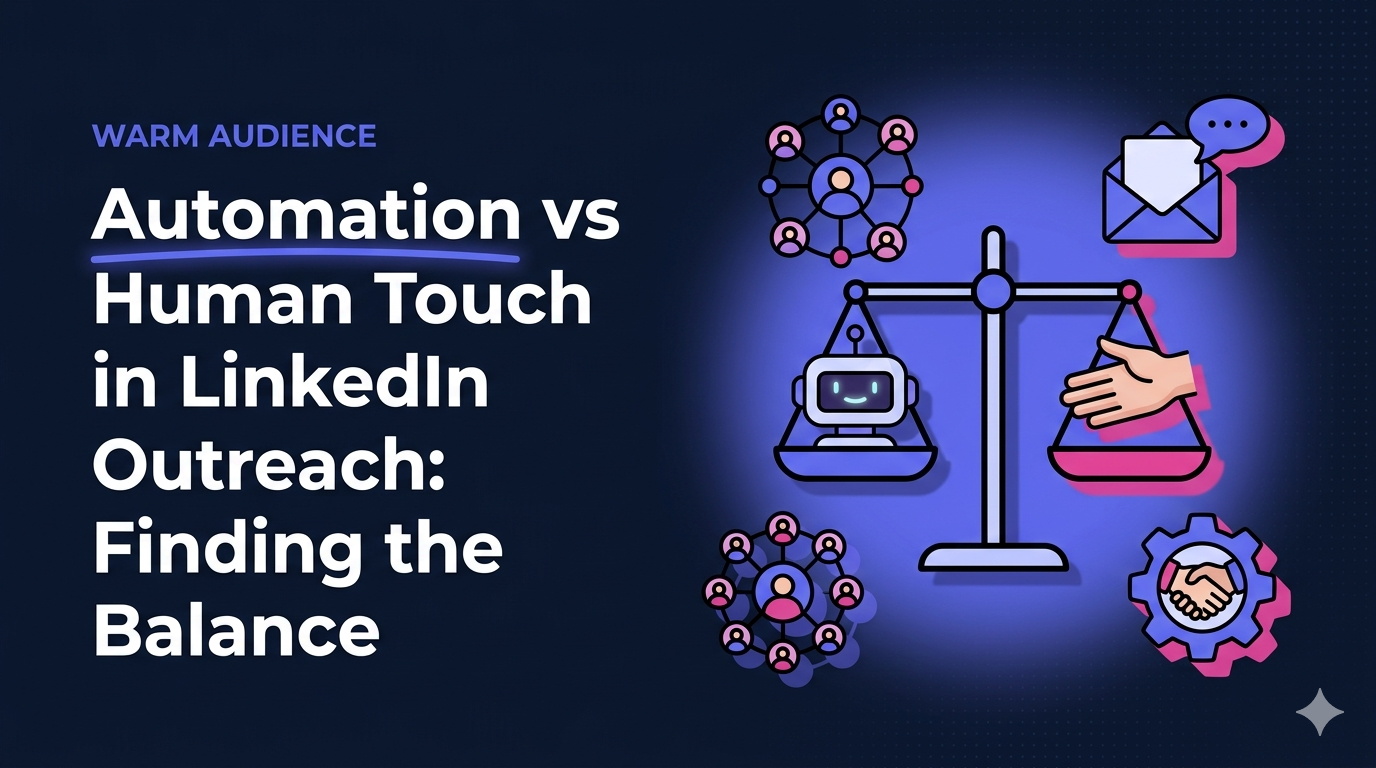
Sales leaders frequently argue on LinkedIn about whether automation is "dead" or whether manual outreach is "too slow." Both are wrong. The highest performing outbound companies in 2026 operate on a strict hybrid infrastructure known as the "Cyborg Model."
The False Dichotomy of B2B Sales
If you speak to a massive RevOps agency, they will tell you that human intervention is slow, expensive, and scales poorly; thus, everything must be automated. If you speak to an old-school Enterprise Account Executive, they will tell you that automation is spam, destroys trust, and burns territories; thus, every email must be hand-typed.
They are both half-correct, which means their execution is entirely wrong.
Why Pure Automation is a Scam
A fully automated system (where software identifies the lead, writes the email, sends the email, handles the reply using an AI chatbot, and attempts to book the calendar link natively) does not work in high-ticket B2B sales.
When a VP of IT is evaluating a $50,000 annual software contract, they are evaluating the competency of the partner. If they suspect they are arguing with a GPT-4 integration that hallucinated a response regarding data compliance, they will instantly terminate the conversation. Automation creates massive volume, but without a human to establish trust at the finish line, the volume converts to zero dollars.
Why Pure Manual Outreach is Unprofitable
Conversely, if you pay an SDR $70,000 a year to click through LinkedIn, copy names into a spreadsheet, manually look up email addresses on Google, and write 30 bespoke emails a day... you will go bankrupt. Your Customer Acquisition Cost (CAC) will vastly outweigh the Lifetime Value (LTV) of the client. Human labor is the most expensive resource in your company. It must only be deployed on tasks that a microchip cannot physically perform: empathy, nuanced negotiation, and building rapport.
Defining the "Cyborg Sales Model"
The Cyborg Sales Model is a rigid structural operating procedure. It utilizes soulless, flawless server automation for the "hunting and gathering" of data, and reserves highly-paid human intelligence exclusively for the "closing" of the data. Below is exactly how to divide your funnel.
Stage 1: Robotic Extraction (The 100% Automated Phase)
A human being should never, under any circumstances, copy and paste data from LinkedIn in 2026.
Let Algorithms Do the Hunting
Discovering your prospect is a mathematical problem, not a creative one.
- You use Google X-Ray scripts to scrape search engines for the exact title of "Head of DevOps."
- You use API Webhooks to monitor competitor LinkedIn posts to scrape anyone who clicks 'Like'.
- You use Apify actors to extract attendee lists from competitor webinars.
Eliminating SDR Data Entry
As outlined in the No-Code Workflow Guide, all this extraction happens while your SDR is sleeping. By utilizing API infrastructure, you are turning physical labor (clicking 'Next Page' 50 times) into a $0.05 compute cost. Your SDR logs in on Monday morning to find 300 highly targeted, intent-driven names already waiting in the CRM.
Stage 2: Robotic Routing & Enrichment
A name and a LinkedIn URL is not a lead. It requires contact information.
The Waterfall Architecture
Again, an SDR should never guess an email block format. You use an automated JSON workflow to ping Apollo, Dropcontact, and Hunter sequentially to guess, verify, and lock down the corporate email address. You use ZeroBounce to ensure the email will not damage your sending domain. This process is 100% automated. A human brain adds zero value to pinging an SMTP server.
Stage 3: The First Touch (The 90% Automated Phase)
This is where the debate truly begins: Should the first email or LinkedIn Connection Request be written by a human or a robot?
The Difference Between "Personalized" and "Relevant"
A human SDR will often waste 15 minutes reviewing a prospect's Twitter feed to find out they like the Chicago Bulls, just so they can write: "Hey John, tough loss for the Bulls last night. Anyway, we sell HR software..." That is "Personalized," but it is absolutely useless. It is a desperate gimmick, and executives see right through it.
What buyers actually want is "Relevance." "Hey John, saw you just attended the HR Tech Webinar yesterday. We built a data mapper specifically for the compliance issue they mentioned. Do you want to see a screenshot?"
Relevance is based on Intent, not hobbies. Because intent is algorithmic (we scraped the event attendees), we can safely automate the first message. The software knows why it is messaging John (he attended the specific event), so the software can inject a perfectly relevant template.
Using AI to Generate Variables
If you want to add nuance, insert an OpenAI node into your Apify workflow. Instruct the AI to read the prospect's LinkedIn 'About' section and generate a single, highly specific compliment regarding their career trajectory. You then inject that AI-generated sentence as a dynamic variable ({{AI_Icebreaker}}) into the opening line of your automated sequence.
Why You Should Never Automate the "Follow-up" to a Reply
The automation ends the exact millisecond the prospect replies to your sequence.
If John replies: "We actually use a legacy system for compliance, so I'm not sure this would integrate." If your automation tool fires a pre-canned "Day 4 Follow-Up" that ignores his specific technical concern and just says "Just bubbling this to the top of your inbox!", you look like an idiot. The trust is gone.
Stage 4: High-Friction Human Intervention (The 0% Automated Phase)
When the prospect replies, the machine pauses. The human steps into the arena.
The Triage System (Categorizing Replies)
If you send 1,000 automated connection requests using intent data, you might get 150 replies. The SDR must 'triage' the inbox manually:
- The Hard No: "Unsubscribe." (Mark as lost, do not argue).
- The Soft No: "Not a priority until Q4." (Set a CRM task for Q4, reply acknowledging their timeline).
- The Technical Question: "Does this connect natively to AWS?" (This is a buying signal. Escalate).
The Hand-Off Protocol (When the SDR Takes Over)
When John asks about AWS architecture, the SDR reads the entire automated thread context. They see John was scraped from the HR webinar, they see John's title, and they synthesize a bespoke, deeply technical human response. "John, great question regarding AWS. We actually use a native Lambda function so you don't have to alter your current environment. Are you the one architecting that side, or should I loop in your CTO?"
This response requires empathy, technical synthesis, and strategic sales navigation. It cannot be reliably automated in 2026 without risking catastrophic AI hallucinations.
Bypassing the "Uncanny Valley" of AI Writers
If you attempt to use ChatGPT to write the human follow-up, you will frequently fall into the uncanny valley.
The Dangers of ChatGPT Copywriting
ChatGPT is trained to be helpful, polite, and grammatically flawless. B2B buyers do not speak this way. If you tell ChatGPT to reply to John, it will output: "Dear John, Thank you so much for your insightful question regarding our AWS integration. I would be absolutely delighted to inform you..."
This triggers an immediate subconscious spam filter in the buyer's brain. It sounds like a corporate press release, not an engineer.
Training Your Infrastructure to Sound "Messy"
If you insist on using AI to draft replies for your SDRs to edit later, you must aggressively constrain the prompt. Prompt: "Write a response confirming we integrate with AWS. Use a maximum of two sentences. Do not use corporate jargon. Use lowercase letters for the first word. Sound like a busy engineer replying from a mobile phone." Output: "yeah we have a native lambda function for AWS. are you running the technical side of the migration?"
This engineered "messiness" simulates authentic human behavior and massively increases the reply rate.
Measuring Human-Centric Metrics
To ensure your Cyborg model is functioning, you must measure the correct KPIs.
Tracking the "Reply to Meeting Booked" Ratio
Many Founders celebrate when their automated LinkedIn campaigns achieve a 20% reply rate. But if the SDR team only converts 1% of those replies into an actual booked discovery call, the campaign failed.
The most vital metric in a modern RevOps stack is the "Reply-to-Meeting Booked Ratio." If the automation is firing perfectly (generating replies) but the SDRs cannot convert the replies to calendar invites, you have correctly isolated the problem. The issue isn't lead generation; the issue is objection handling and sales training.
Diagnosing the Broken Link in the Funnel
- High Open Rate, Low Reply Rate: The intent data (the list) is good, but your automated script (the sequence) is too aggressive or irrelevant.
- High Reply Rate, Low Conversion Rate: The automation is excellent, but your human SDRs are failing to maneuver the prospect from "curious" to "committed."
How WarmAudience Bridges the Gap
Companies often struggle to implement the Cyborg Model because their software tools are fragmented. You scrape in Apify, enrich in Apollo, sequence in Lemlist, and chat in LinkedIn. The UI friction burns the SDR out.
BYOK (Bring Your Own Key) environments like WarmAudience are designed specifically for the Cyborg methodology. They handle the Apify intent extraction and the Apollo enrichment silently in the background (Stages 1 and 2), they deploy the initial automated sequences (Stage 3), and then they provide a unified "Unified Inbox" dashboard where the human SDR sits waiting to jump into the threaded conversations to execute Stage 4 manually.
Empowering the Account Executive
By offloading the mechanical extraction of B2B data to cloud APIs, you are not replacing your sales team. You are elevating them. An SDR who is forced to copy-paste URLs and guess email addresses for 6 hours a day is a miserable, inefficient employee. An SDR who logs into a dashboard containing 50 live, intent-driven conversations, and spends their entire day actively consulting and negotiating with high-level executives, is an empowered revenue generator. Automate the data. Humanize the sale.