B2B Lead Lists vs LinkedIn Scraping: A Cost and Quality Comparison
Should you pay $20,000 for a zoomInfo database contract or build a $200/month LinkedIn scraping engine? A deep dive into B2B data decay, intent sourcing, and true ROI.
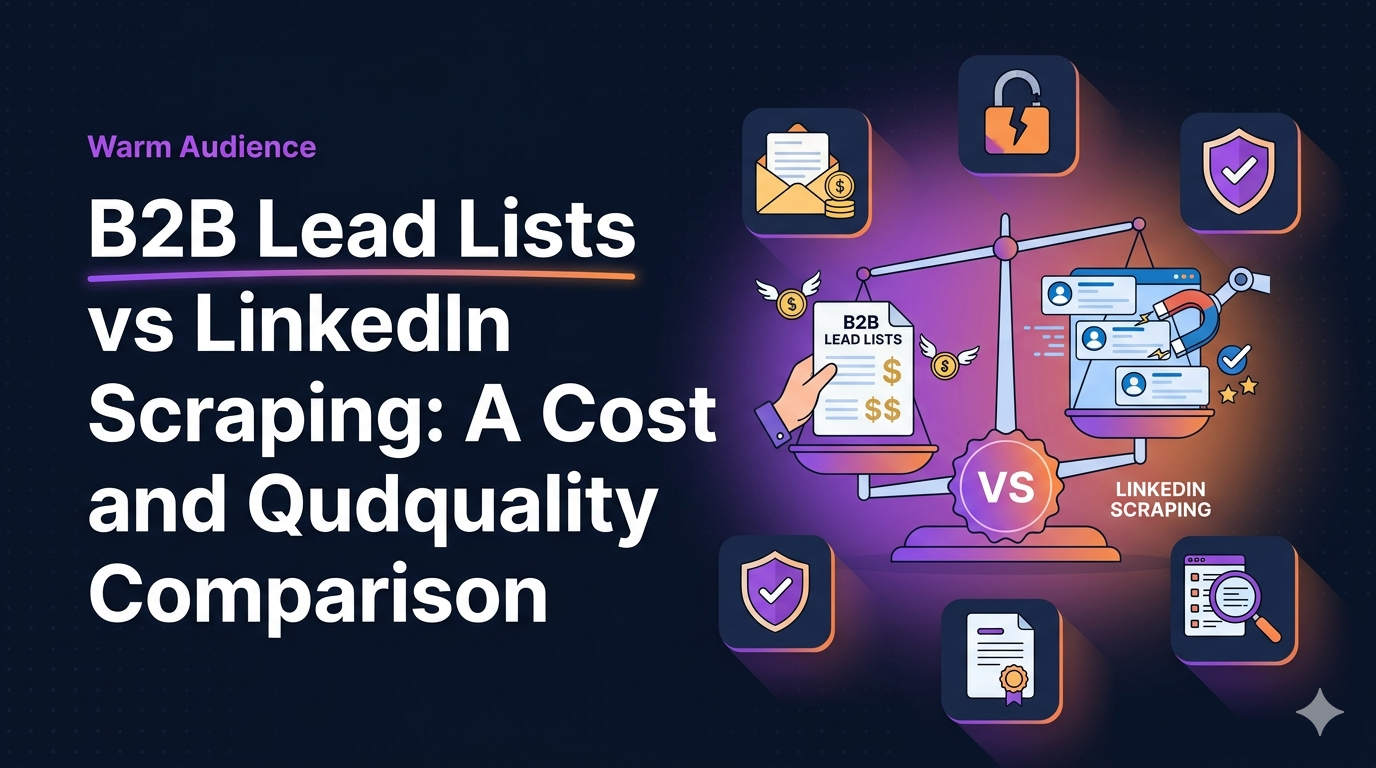
This guide breaks down the most fiercely debated topic in Revenue Operations (RevOps): Do we sign a massive annual contract with a legacy data provider, or do we build an agile, in-house infrastructure using LinkedIn scraping tools? The answer dictates your outbound profit margins.
The Illusion of the "50-Cent Lead"
When a Founder decides to launch a cold email outbound operation, the very first instinct is to Google "buy B2B lead list." They will quickly find hundreds of Fiverr gigs or automated database tools promising "10,000 Verified B2B Emails for $500." The math is intoxicating. If a lead only costs 5 cents, and you close just one $10,000 enterprise deal from the list of 10,000, your Return on Investment (ROI) is staggering.
The reality, however, is brutal.
The Era of the Pre-Packaged Lead List is Over
In 2026, email servers (Google Workspace, Microsoft Outlook) operate heavily protected, AI-driven spam filters. If you purchase a generic, static list of 10,000 emails, it is mathematically guaranteed that at least 15% of those emails will 'hard bounce' (the inbox no longer exists) and another 40% will belong to people who haven't logged in for six months. When you blast a campaign to a decayed list, Google detects the miserable open rates and the high bounce rates, and permanently blacklists your company's domain. Your outbound machine dies before it even generates a single meeting.
Why B2B Databases Go Stale
At the enterprise level, companies evaluate massive data brokers like ZoomInfo, Apollo, or Lusha. These platforms charge anywhere from $5,000 to $50,000 a year for access to their databases.
The Math of Data Decay (The "30% Rule")
B2B data does not age like fine wine; it ages like milk. On average, employment data decays at a rate of 2.5% to 3% every single month. People quit, people are fired, companies rebrand, and domains merge. Over a 12-month period, a database of 1 million tech executives will suffer a 30% inaccuracy rate.
If a multi-billion dollar data broker aggregates 50 million profiles, physically verifying those 50 million data points every single month is mathematically impossible. They build algorithms to "guess" if the email is still valid, but the core data is fundamentally static.
The Fundamental Difference: Static Data vs Real-Time Extraction
To understand your options, you must understand the mechanical difference in how the data is generated.
What is Static Data?
Static Data (buying lists or using standard database tools) means you are querying a database that a third party built in the past. If you search ZoomInfo for "VP of Sales in Chicago," the platform checks its internal server and says, "According to a scrape we did 8 months ago, and an email signature we bought 4 months ago, this person is a VP of Sales."
What is Real-Time Extraction?
Real-Time Extraction (LinkedIn Scraping) means you are querying the live internet today. When you use an infrastructure tool like WarmAudience or a custom Apify actor (detailed in the Free API Tiers Guide), the software opens a live connection to a person's LinkedIn profile at the exact millisecond you hit "Extract." If that person updated their job title two hours ago to say "Unemployed," your scrape will instantly reflect that, saving your SDR from sending an embarrassing cold email.
A Deep Dive into B2B Lead Databases
Despite the decay, massive legacy databases hold a dominant market position for a reason. They solve the speed-to-scale problem.
How Legacy Data Brokers Actually Get Their Data
Most established data platforms acquire data through extremely aggressive, ethically gray telemetry:
- Free apps & Plugins: They distribute free email signature generators or CRM plugins. When a user installs it, the plugin silently reads the headers of every email the user sends/receives, capturing the names, titles, and phone numbers of the user's contacts.
- Corporate Acquisitions: They buy massive datasets from bankrupt companies or marketing agencies.
- Massive IP Scraping: They run thousands of automated server racks pulling public data off the internet continuously.
The Plight of the SMB and Mid-Market Account
The major flaw with legacy databases is their enterprise bias. If you want the email of the CFO at Fortune 500 companies (like Microsoft or Ford), ZoomInfo is spectacularly accurate, because those executives have massive digital footprints.
If you are trying to sell localized software to a 50-person HVAC company in Ohio, the database tools fall apart. The data is usually wildly inaccurate, outdated, or completely missing, because small businesses do not generate enough digital interaction for the data brokers' algorithms to catch them.
Where Pre-Packaged Lists Still Excel (Enterprise Mapping)
If your Sales team targets "Whale" accounts (deals over $100k ACV), legacy databases are phenomenal for Account Mapping. You do not use them to blast cold emails; you use them to construct an org chart. You look up AcmeCorp, immediately see the hierarchy of 40 different Directors and VPs, and then you cross-reference those names manually to confirm they are still employed before launching a surgical, highly customized multi-touch campaign (see Cold Email vs InMail Guide).
A Deep Dive into LinkedIn Scraping Infrastructures
If legacy databases provide a massive, slightly stale pond, LinkedIn scraping provides a perfectly fresh, highly specific river.
Intent Sourcing: Scraping Beyond Job Titles
The single biggest advantage of LinkedIn scraping over a static database is behavior-based targeting. A static database tells you: "John is a CMO." LinkedIn Scraping allows you to say: "Show me every CMO who attended a webinar about AI implementation yesterday," or "Show me every CMO who commented angrily on my competitor's LinkedIn post this morning."
As covered in our 10 Creative Uses for Engagement Data, extracting intent-based data guarantees that your cold outreach achieves reply rates exponentially higher than a static campaign, because you are referencing a behavior the prospect just performed.
The "Job Change" Trigger
LinkedIn Scraping excels at event-based triggers. The highest converting B2B outbound campaign is the "90-Day Transition" sequence. When a new Director of IT is hired, they usually spend their first 90 days replacing legacy software and bringing in new vendors. By running an automated LinkedIn scrape that triggers alerts strictly when someone in your target demographic updates their current job title, you ensure you are sending your pitch at the precise moment they have budget authority and evaluation intent. Static databases often take 6 to 12 weeks to register these job changes, putting your sales team far behind the curve.
How Technical Scraping Actually Works
It is no longer 2018; you do not need to install dangerous Chrome extensions that risk getting your profile banned. Modern operations use BYOK (Bring Your Own Key) architectures or centralized Dashboards that leverage residential proxies to intercept raw JSON data from LinkedIn's servers. They pull 2,000 perfectly formatted, real-time records in less than three minutes without ever exposing your primary account to platform velocity bans. (Read APIs vs Browser Scraping for LinkedIn).
The True Cost Comparison (ROI Analysis)
To make a business decision, we must calculate the true unit economics of both models.
The $20,000 Enterprise Contract vs The BYOK Architecture
The Legacy Model: You sign a $15,000 to $25,000 annual contract with a tier-one database provider. You receive access to a beautiful UI and 10,000 export credits a month. You are forced to pay the entire contract upfront.
The Scraping Model: You set up a BYOK system using Apify, or you use a streamlined tool like WarmAudience.
- You pay wholesale cloud compute costs to scrape the LinkedIn data ($0.001 per profile).
- You pay an email enrichment API like Dropcontact or Apollo $50/month to find the emails for the scraped names.
- Total Monthly Cost: ~$150. Total Annual Cost: ~$1,800.
The Scraping Model represents over 90% in software savings, while fundamentally delivering higher-intent data.
The Hidden Costs of Bad Data (Domain Blacklisting)
If you operate the $20,000 legacy contract, and your SDRs blindly load lists of 5,000 static emails into a sequencing tool, the 15% bounce rate will destroy your sending domain. To fix a burned Google Workspace domain requires migrating your email infrastructure, updating all company signatures, rebuilding your IP reputation, and hiring an email deliverability consultant. Those hidden costs can easily exceed $15,000 in lost revenue and engineering time. Because scraped data is pulled in real-time, and then passed through an immediate validation API, your bounce rate stays below 1%, protecting the most vital asset your company owns: its email deliverability score.
The Scaling Ceiling of Native Scraping
Scraping is not perfect. Its flaw is speed. While a legacy database can give you 100,000 leads in two clicks, attempting to mechanically scrape 100,000 profiles from LinkedIn safely will take weeks of architectural engineering and massive proxy management. If your company requires extreme, massive volume, you must adopt the Multi-Account LinkedIn Scraping strategy.
The Ultimate Hybrid Engine: Scraping + Enrichment
The fatal flaw of novice marketers is assuming that "LinkedIn Scraping" and "B2B Databases" are mutually exclusive. The absolute pinnacle of B2B RevOps architecture is combining them.
Why LinkedIn Scraping Alone Fails (The Missing Email)
When you scrape a LinkedIn profile, you get pristine, real-time data regarding the person's name, company, headline, and job history. What you do not get is their corporate email address. LinkedIn actively hides email addresses behind the 1st-degree connection firewall, and even then, 80% of users register with a personal Gmail address rather than their corporate email.
If you just scrape LinkedIn, you cannot send cold emails. You are restricted to sending LinkedIn connection requests, severely hindering your volume due to algorithm limits (approx 100 per week).
The "Waterfall Enrichment" Protocol
The ultimate engine looks like this:
- The Scrape: Your automation tool mechanically scrapes a LinkedIn Event attendee list (High Intent, Real Time Data).
- The Output: The scraper produces a CSV containing "First Name, Last Name, Exact Company URL, Job Title".
- The Enrichment Waterfall: You pass this real-time list into a B2B Database API (like Apollo or Dropcontact).
- The database acts as a calculator. It uses its massive historical records and algorithmic corporate domain structures (e.g.,
first.last@company.com) to generate the email address for the pristine names you literally just proved exist in real-time. - Validation: The final email list is pinged against an SMTP validation server (like ZeroBounce) to confirm it will not bounce.
This Hybrid Engine is the exact architecture that powers tools like WarmAudience. It produces a list with the intent-accuracy of real-time scraping, but the email penetration depth of an enterprise database.
Operational Realities for RevOps Teams
Choosing between a massive database contract and a scraping architecture also affects your human capital.
The Time-to-Value Metric
A massive database allows an SDR to log in on Day 1, click a button, download 500 names, and start dialing. It is idiot-proof. A scraping architecture requires a more technically proficient SDR. They must learn how to construct Boolean searches, how to use Google X-Ray to find profiles, and how to operate the event scraping tools. It requires a slightly longer onboarding period but yields a vastly superior salesperson who understands why they are messaging someone.
SDR Burnout and List Fatigue
When SDRs are handed a pre-packaged static list and told to "dial for dollars," they burn out incredibly fast. The conversion rates are abysmal, and the rejection rates are miserable. When SDRs are taught to scrape high-intent engagement data (messaging people who specifically commented on an industry pain point), they get positive replies. Their morale skyrockets, decreasing employee churn—which saves the company tens of thousands of dollars in recruitment fees.
Legal and Compliance Considerations
Any discussion of mass data extraction must address the legal realities of 2026.
GDPR Implications for Both Methods
If you are selling into the European Union, the General Data Protection Regulation (GDPR) applies heavily.
Pre-Packaged Lists: Buying a massive list of EU data from a questionable broker and cold emailing them is highly dangerous. You must prove you legally obtained the data and that you have a "Legitimate Interest" in contacting them. If the broker scraped the data unethically, your company assumes the liability. Real-Time Scraping: Scraping public, self-reported B2B professional data from LinkedIn to identify a prospect is generally considered safer, provided your subsequent email establishes a highly specific business case (Legitimate Interest) and offers an immediate opt-out mechanism.
(For a complete breakdown of EU legal architecture, read the GDPR & LinkedIn Scraping Compliance Guide).
Navigating the LinkedIn Commercial Use Limit
If you attempt to rapidly pull 50 pages of search results on LinkedIn without a premium subscription, you will hit the "Commercial Use Limit," and your search functionality will be frozen until the end of the month. You must either invest in a single seat of Sales Navigator or use off-platform search methods (like Google X-Ray) to source the target profiles before executing the API scrape.
Conclusion: What Should You Build in 2026?
The decision comes down to the size of your team and the Annual Contract Value (ACV) of your product.
If you are an enterprise corporation with 150+ SDRs tasked with blanketing entire global territories, you mathematically require a $50k enterprise database contract simply to sustain the sheer velocity of data required to feed an army of salespeople.
If you are a startup, an agency, or a mid-market SaaS company with fewer than 10 SDRs, signing an expensive, multi-year static database contract is a waste of capital. Your ultimate competitive advantage is agility and personalization. You must build an inbound/outbound hybrid engine. You use LinkedIn Polls and Posts to generate organic intent, use API scraping to extract that high-intent engagement data, and use Waterfall Enrichment to run surgical, high-converting cold email campaigns.
Stop spraying static lists; start extracting real-time intent.